Munnar & Alleppey 3 Night 4 Days 2 Pax Itinerary Day 1: Cochin to Munnar Pick up and proceed to...
Every Kerala tour starts in Ernakulam. That is not a coincidence — it is geography. Cochin International Airport is the state’s busiest, the railway station connects to the entire country, and the road network fans outward from here to Munnar, Alappuzha, Thekkady, and every other point on the Kerala circuit.
Because of this, most travellers treat Ernakulam as a starting block rather than a destination. They land, check in, sleep, and leave the next morning. That is understandable. It is also a mistake.
Ernakulam and its island extension Fort Kochi contain some of the most historically layered urban territory in South India. Jewish, Portuguese, Dutch, and British influences left buildings, streets, markets, and institutions that are still standing and still functioning. The waterfront is genuinely beautiful. The food scene is among the best in Kerala. The ferry network connecting the mainland to its islands is one of the most pleasant ways to move through any Indian city.
Munnar & Alleppey 3 Night 4 Days 2 Pax Itinerary Day 1: Cochin to Munnar Pick up and proceed to...
8-Day Enchanting Kerala Escape Itinerary Day 1: Arrival at Cochin Pick up at cochin, visit Dutch palace, Jewish synagogue, chinese...
6-Day Enchanting Kerala Escape Itinerary Day 1: Arrival at Cochin Pick-up: Cochin Airport / Railway Station Proceed to hotel check-in...
Colonial history and Chinese fishing nets.
City promenade with sunset views.
Man-made island with major port views.
Dr. Salim Ali’s favorite birding spot.
Major theme park for families.
Dutch palace with vibrant murals.
Beach and backwater meeting point.
Dutch-built island palace.
The massive "Niagara of India."
Oldest active synagogue in the Commonwealth.
Largest archaeological museum in Kerala.
River-side elephant camp.
Forest-fringed cascades near Athirappilly.
Ernakulam is the mainland city — the commercial centre, the railway station, the bus terminus, and the business district. Kochi (or Cochin) is the broader metropolitan area that includes Ernakulam, Fort Kochi, Mattancherry, Willingdon Island, and the surrounding islands. Cochin is the anglicised name used historically and still common in tourism marketing. Fort Kochi is the specific peninsula on the western side of the harbour that holds the colonial heritage buildings.
In practice, when travellers say “Cochin” they mean the entire area. When locals say “Ernakulam” they usually mean the mainland. When anyone says “Fort Kochi” they mean the old colonial quarter. This guide uses all three names the way they are actually used — which is to say, interchangeably except where the distinction matters.
Fort Kochi is where Ernakulam stops being a transit city and becomes a destination. The peninsula sits across the harbour from the mainland, reachable by ferry in seven minutes, and it operates at a completely different tempo from the rest of the city.
The streets here are narrow and mostly walkable. The buildings are Portuguese, Dutch, and British colonial — some restored, some deliberately left in their original faded state, some turned into cafes and guesthouses without losing their architectural character. Bougainvillea grows over whitewashed walls. Hand-painted signs mark art galleries that were once spice warehouses. The whole quarter has the quality of a place that became interesting before anyone decided to make it a tourist destination — which means it still feels genuine despite the visitors.
A half-day walking tour of Fort Kochi covers more history per kilometre than almost any other walk in Kerala. However, the best way to experience it is without a fixed plan — arrive early, walk slowly, and let the streets lead.
The Chinese fishing nets (cheena vala) at the Fort Kochi waterfront are Kerala’s most photographed landmark. They are enormous fixed cantilever nets — each one supported by a system of bamboo and teak poles, counterbalanced by large stones, and operated by a team of four or five fishermen who lower and raise them on a tidal rhythm.
The nets were introduced to Kerala by traders from the court of Kublai Khan in the 13th or 14th century. That makes them one of the oldest continuously operating fishing technologies on the Kerala coast — and they still produce a catch, though the economics of maintaining them now depend partly on tourism.
The best time to see them is at sunrise. The light at that hour — soft, golden, reflecting off the harbour — is why this image appears in every Kerala travel photograph ever taken. Get there before 6:30 AM and you will have relative quiet, good light, and a genuine sense of the working waterfront before the tour groups arrive.
You can buy fresh fish directly from the fishermen after each haul and have it cooked immediately at one of the stalls set up just behind the nets. The fish is as fresh as fish gets. The cooking is simple — fried or grilled with minimal spicing. Eating it sitting on the harbour wall with the nets still dripping behind you is an entirely specific Kochi experience.
About two kilometres south of the Chinese fishing nets, on the Mattancherry waterfront, is the palace that the Portuguese built in 1555 and later gifted to the Raja of Cochin. The Dutch renovated it significantly in 1663, which is why it is also called the Dutch Palace — though neither name fully captures what is actually most remarkable about it.
The murals inside are among the finest examples of Kerala mural painting anywhere in the state. They cover the walls and ceilings of the bedrooms and coronation hall in dense, vivid scenes from the Ramayana, the Mahabharata, and the Puranas — painted in natural pigments that have held their colour for centuries with minimal restoration.
Most visitors spend 20 minutes inside. That is not enough. The murals reward close attention — figures overlap, narrative sequences run across entire walls, and the detail in individual faces and costumes is extraordinary. Budget at least 45 minutes. Go on a weekday morning when it is less crowded.
Closed on Fridays. Entry fee is nominal.
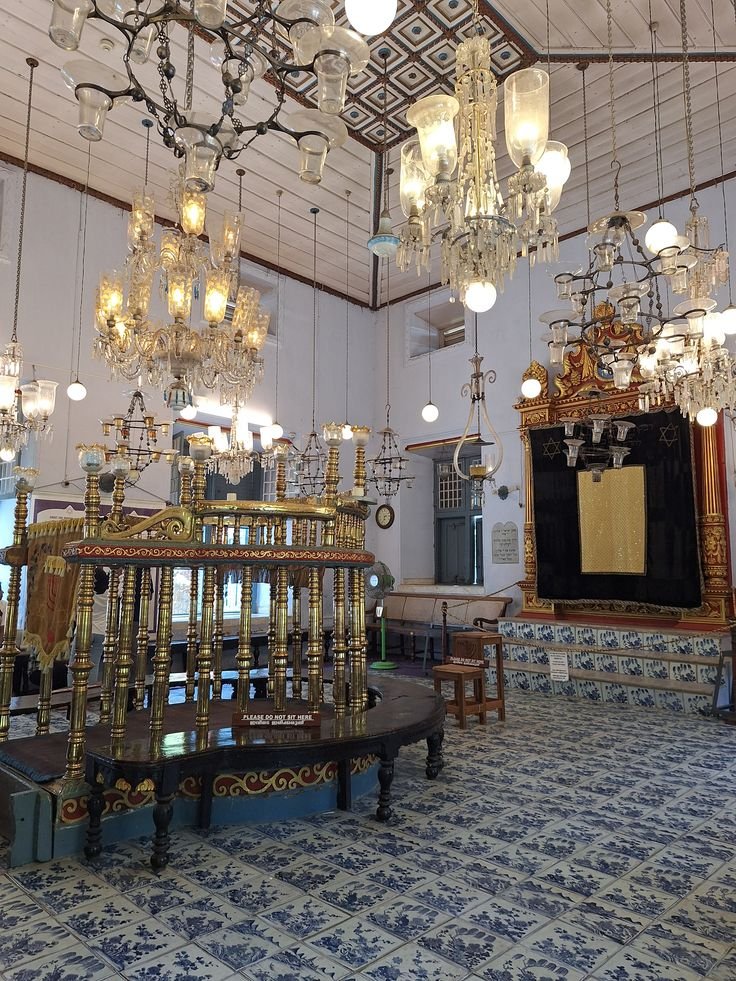
Walk from Mattancherry Palace toward the waterfront and within three minutes you enter Jew Town — the quarter that housed Kochi’s Jewish community for nearly 500 years. The Paradesi Synagogue at the end of Synagogue Lane, built in 1568, is the oldest active synagogue in the Commonwealth of Nations.
Inside, the floor is covered in hand-painted blue-and-white Chinese ceramic tiles — each one slightly different, no two patterns repeated — brought from Canton in the 18th century. Belgian glass chandeliers hang from the ceiling. The ark holds Torah scrolls that are centuries old.
The community that built and maintained this synagogue has almost entirely left — emigration to Israel reduced the Kochi Jewish population from thousands to fewer than ten people today. The synagogue is now maintained partly by a broader community effort and is open to visitors on most days. That the building exists, functions, and is accessible is itself a small miracle of heritage preservation.
The street leading to the synagogue — Synagogue Lane — is lined with shops selling antiques, spices, Kashmiri crafts, and Kerala brassware. The antique shops in particular are worth entering — old colonial furniture, bronze lamps, and genuinely old ceramics appear alongside tourist-grade items, and the owners generally know exactly what each piece is.
The public ferry from Ernakulam Main Jetty to Fort Kochi Customs Jetty takes approximately seven minutes and costs a few rupees. It runs frequently throughout the day and is used primarily by local residents commuting between the mainland and the islands.
Taking the ferry rather than a road taxi to Fort Kochi is the correct choice for two reasons. First, it gives you a view of the harbour from the water — the Chinese fishing nets visible to the north, the container port to the south, and the old waterfront buildings of Fort Kochi ahead. Second, it places you on the western side of the peninsula, a five-minute walk from the fishing nets, rather than arriving from the road on the eastern side.
In addition to the Fort Kochi ferry, the Ernakulam harbour is served by multiple ferry routes connecting the mainland to Willingdon Island, Bolgatty Island, and Vypeen Island. Taking at least one of these ferry rides — even without a specific destination — is one of the most pleasant things you can do in Kochi. The harbour is busy, the light on the water is good, and the view of the city from the water puts its geography in context.
Bolgatty Island sits in the middle of the Kochi harbour, accessible by ferry from the Ernakulam high court jetty in about ten minutes. The island is dominated by Bolgatty Palace — built by the Dutch in 1744, making it one of the oldest Dutch-built palaces outside the Netherlands — now converted into a heritage hotel operated by the Kerala Tourism Development Corporation.
Even if you are not staying at the hotel, the island is worth visiting. The grounds are quiet, the waterfront view back toward the city is one of the better perspectives on Kochi’s skyline, and the pace is noticeably different from the mainland. Bolgatty is the kind of place you go to decompress mid-trip — an hour or two on the island, walking the waterfront, watching the harbour traffic, eating at the hotel restaurant if open, and taking the ferry back.
Because it is neither famous enough to be crowded nor unknown enough to be inaccessible, it sits in a useful middle ground.
Marine Drive is the waterfront promenade that runs along the eastern edge of Ernakulam, facing the harbour and the islands. It is a long, wide, well-maintained walkway with benches facing the water — and on weekday evenings, it is where the city comes to exhale.
The rainbow bridge at the northern end is a covered pedestrian walkway that curves over the backwater inlet — popular for photographs and pleasant to walk across at sunset. The view from the bridge takes in the harbour, the distant mangroves of the islands, and the city skyline behind you.
The Marine Drive area is also where the city’s best ice cream parlours, chaats, and evening snack stalls cluster. Consequently, any evening visit that starts as a waterfront walk tends to become a progressive food crawl through the stalls without requiring any planning.
What makes Marine Drive work is that it is genuinely used by local residents — not staged for visitors. Families, couples, elderly walkers, school groups, and office workers all share the promenade in the early evening. That mix of people is what gives it its particular atmosphere.
Thirty-five kilometres north of Ernakulam town, on Vypeen Island, is Cherai Beach — one of the few places on the Kerala coast where backwaters and the Arabian Sea exist simultaneously within walking distance.
The beach itself is long, relatively uncrowded by Kerala standards, and clean. The water is calmer here than at Kovalam, making swimming more accessible. Dolphins are sighted regularly from the beach — not as a scheduled attraction but as an incidental occurrence, particularly in the early morning when fishing boats are returning.
The backwater side of Vypeen Island — a short walk or cycle from the beach — passes through coconut groves, paddy fields, and small canals. The contrast between standing on an open beach and then turning into a narrow canal lane fifteen minutes later is one of the more unusual geographic experiences available on a Kerala day trip.
Cherai is reachable from Ernakulam via the Vypeen ferry from Fort Kochi Jetty, followed by a 30-minute drive or auto ride. The ferry journey itself crosses an active fishing channel and is worth taking slowly. Therefore, allow at least half a day — a full day is better.
About 12 kilometres east of Ernakulam town, in Tripunithura, is the Hill Palace Museum — the largest archaeological museum in Kerala and the former administrative palace of the Kochi royal family.
The complex covers 52 acres and includes the palace building itself — a traditional Kerala palace with 49 rooms spread across multiple buildings — and extensive grounds with a deer park, heritage monuments, and a prehistoric park with life-size replicas of extinct animals.
Inside the museum, the collection includes royal artifacts, paintings, manuscripts, coins, thrones, palanquins, and personal effects of the Kochi royal family spanning several centuries. The scale of the collection is genuinely surprising — most visitors do not expect this level of material in a museum this little-discussed.
Despite its size and the quality of its collection, Hill Palace receives a fraction of the visitors that Fort Kochi gets on any given day. For travellers with an interest in Kerala’s royal history who want to see it without crowds, the museum is one of the better-kept secrets in the Ernakulam area.
Open: 9 AM – 5 PM. Closed on Mondays.
In the middle of Ernakulam city, surrounded by buildings on all sides, is Mangalavanam Bird Sanctuary — 2.74 acres of mangrove forest that functions as a roosting and breeding site for over 100 species of resident and migratory birds.
The existence of this sanctuary — officially protected despite being entirely within the urban fabric — is itself remarkable. During the October to March migratory season, the trees at dusk hold hundreds of night herons, little egrets, and pond herons roosting simultaneously. The noise and the spectacle of that many birds arriving in a small urban forest is something that has no equivalent in any other Kerala city.
Entry is free. The sanctuary is open in the morning and evening. It takes 20 to 30 minutes to walk through. For birdwatchers, it is an essential stop. For everyone else, it is a genuinely surprising urban experience — standing in a forest while the city continues on the other side of the wall.
Ernakulam has the most diverse food scene of any city in Kerala. The combination of a large permanent population, a significant business community, tourist infrastructure, and the natural abundance of the coast and backwaters means the quality and variety of food here is consistently high.
Appam with Stew: The defining breakfast of Kerala’s Christian communities — thin, lacy rice hoppers with a mild coconut milk stew of vegetables or chicken. Available at small restaurants across Fort Kochi and Ernakulam from early morning. Order it at a place where locals are eating, not at a hotel breakfast buffet.
Karimeen Pollichathu: Pearl spot fish marinated in spice paste, wrapped in banana leaf, and roasted. It appears on menus across Ernakulam but the best versions are at small family-run restaurants near the fish market, where the fish arrived that morning.
Prawn dishes: The Kochi harbour gives Ernakulam access to some of the best prawns on the Kerala coast. Prawn biryani at the Muslim eateries around Broadway market is a specific recommendation — the rice is spiced more assertively here than in hotel versions and the prawns are larger.
Thalassery Biryani: The northern Kerala biryani style — using kaima rice, shorter grained and more fragrant than basmati, with a distinct flavour profile — is available at specialist restaurants in Ernakulam and worth seeking out specifically.
Fort Kochi cafes: The conversion of old colonial buildings into cafes has produced several genuinely good coffee and light-meal establishments in Fort Kochi. The food quality varies but the settings are consistently interesting — high-ceilinged rooms, antique furniture, harbour views from upstairs windows.
Broadway Market and surrounding lanes: The wholesale and retail market area around Broadway in central Ernakulam is where the city’s food supply moves. The street food in this area — fried snacks, fresh coconut water, sugarcane juice, parottas with curry — is cheap, fast, and authentic. Go hungry.
Because Ernakulam sits at the centre of Kerala’s road and rail network, it offers access to several worthwhile destinations within a 2-hour radius.
Alappuzha (Alleppey): 53 kilometres south, 1.5 hours by road. The backwaters of Alappuzha make this the most popular day trip from Ernakulam — though a day is the minimum and an overnight houseboat stay is the fuller experience. View Alappuzha details in our destination guide.
Munnar: 130 kilometres east, 3.5 to 4 hours. The drive into the hills makes this a long day trip but a feasible one. More practically, Munnar works as the first overnight stop of a Kerala circuit starting from Cochin — which is how our packages structure it.
Thrissur: 74 kilometres north, about 1.5 hours. Kerala’s cultural capital, home to the Vadakkunnathan Temple and the Thrissur Pooram — one of the most spectacular temple festivals in South India, held in April or May. Worth a day visit if your dates align with the festival.
Athirapilly Waterfalls: 78 kilometres northeast of Ernakulam, the Athirapilly Falls are the largest waterfalls in Kerala — 80 feet high, set within a teak forest. They have appeared in multiple film productions and are visually impressive. However, they are crowded on weekends and the entry queue can be long. Visit on a weekday morning for a manageable experience.
| Season | Months | What to Expect |
|---|---|---|
| Peak / Best | November – February | Cool, dry, ideal for Fort Kochi walks and harbour activity |
| Shoulder | March – May | Warm and humid, fewer tourists, good hotel rates |
| Monsoon | June – September | Heavy rain, dramatic harbour, indoor cultural activities |
| Post-monsoon | October | City is green and fresh, transitional weather, excellent value |
Unlike the hill stations of Idukki, Ernakulam is a year-round city. The monsoon does not shut it down — in fact, the harbour and the canals during heavy rain have a dramatic quality that the dry season does not. Fort Kochi in the monsoon, with empty streets and rain on the old buildings, is genuinely atmospheric. However, outdoor beach and ferry experiences are more limited during June through August.
Ferries: The most efficient and most pleasant way to move between Ernakulam mainland, Fort Kochi, Mattancherry, Bolgatty Island, and Vypeen Island. Frequent, cheap, and the view from the water is always worth it.
Auto-rickshaws: Widely available across the city. Use the meter or agree a price in advance. For short distances within Ernakulam town, autos are the standard option.
App-based cabs: Ola and Uber operate reliably in Ernakulam. Useful for longer distances — Hill Palace, Cherai Beach, Athirapilly — where autos either cannot go or quote unreasonable prices.
Walking: Fort Kochi and Mattancherry are best covered entirely on foot. The distances between the Chinese fishing nets, Mattancherry Palace, and Jew Town are small enough that walking is faster than waiting for transport. Wear comfortable shoes — the streets are uneven.
Local buses: KSRTC and private buses connect Ernakulam to surrounding towns frequently and cheaply. Useful for Thrissur and other day-trip destinations if you prefer not to hire a car.
Ernakulam is the starting and ending point of both our main Kerala packages — and for good reason. The airport, the railway station, and the road connections all converge here. That practical centrality makes it the logical anchor of any Kerala circuit.
Day 1 arrival: Our 5 Nights 6 Days and 7 Nights 8 Days packages both begin with an Ernakulam pickup — airport or railway station — and proceed to the first destination. Fort Kochi sightseeing is typically covered on the return leg, on Day 5 of the 5N6D package, when the circuit comes back through Ernakulam from Alappuzha.
For travellers arriving a day early or departing a day late, Ernakulam and Fort Kochi easily fill a full day — the fishing nets, Mattancherry Palace, Jew Town, Marine Drive, and a harbour ferry ride constitute a complete and unhurried itinerary.
View 5 Nights 6 Days Kerala Package → https://bestkeralatourpackages.com/trips/kerala-tour-package-5-nights-6-days/
View 7 Nights 8 Days Kerala Package → https://bestkeralatourpackages.com/trips/kerala-tour-package-7-nights-8-days/
View all packages → https://bestkeralatourpackages.com/trips/
| Details | |
|---|---|
| Best known for | Fort Kochi heritage, Chinese fishing nets, harbour |
| Top attraction | Mattancherry Palace murals and Paradesi Synagogue |
| Hidden gem | Mangalavanam Bird Sanctuary inside the city |
| Best time to visit | November – February |
| Airport | Cochin International Airport — 28 km from city centre |
| Railway station | Ernakulam Junction and Ernakulam Town — both central |
| Suits | All traveller types — first-timers, history lovers, food seekers, families |
Yes. It is one of the safest cities in Kerala for solo travel, including solo women travellers. The fort Kochi area is particularly well-suited to solo exploration — walkable, well-lit, with cafes and guesthouses that attract a mix of domestic and international visitors.
Dolphin sightings are common but not guaranteed. They are most frequent in the early morning when fishing boats are returning. There is no organised dolphin tour — the sightings are incidental, which is precisely what makes them worth experiencing.
The public ferry from Ernakulam Main Jetty to Fort Kochi Customs Jetty. It takes seven minutes, costs almost nothing, and gives you a harbour view. Taking a road taxi instead is slower and more expensive and misses the point entirely.
One full day covers Fort Kochi, Mattancherry, and Marine Drive comfortably. Add a second day for Cherai Beach, Hill Palace, Bolgatty Island, and Mangalavanam. Most Kerala tour packages use Ernakulam as the arrival and departure point, with Fort Kochi sightseeing built into the last day of the circuit.




Best Kerala Tour Packages is a specialized division of
Pravas Sukhacha™
Network & Ecosystem.
Pravas Sukhacha Office 201, 2nd Floor, Raigad Complex, Salatwada Main Road, Vadodara – 390001, Gujarat
Business Hours:
Monday to Saturday: 10:00 AM – 7:00 PM
Sunday: Closed
Copyright © 2026 All Right Reserved BEST KERALA TOUR PACKAGES